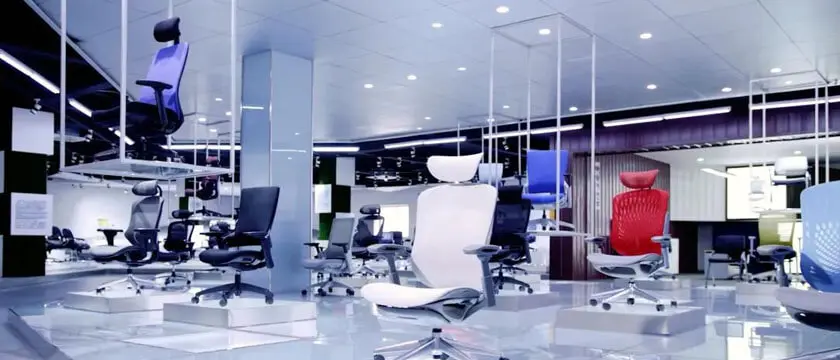
Forty years ago, a small county in northwestern Zhejiang built China’s first five-star swivel chair. Today, that county—Anji—is the largest office chair R&D and production base in the world, and the chair under you right now has a decent chance of having been born there.
The Numbers Behind the Title
Anji is the only region in China awarded the title “Hometown of China’s Chair Industry” by the China National Furniture Association and the China National Light Industry Council. According to Anji government releases reported by provincial media:
- Anji is home to more than 1,200 chair-making enterprises (over 1,700 companies across the broader green home-furnishing cluster), with chair industry output value reaching roughly ¥31 billion in 2024 (up 6.4% year on year).
- The county accounts for about one-third of China’s chair production and half of China’s chair exports; local officials describe it as “one in three chairs made in China comes from Anji.”
- Anji’s office chair export value has ranked first in China for ten consecutive years, shipping to over 190 countries and regions.
- The cluster includes three listed furniture companies on China’s A-share market: Henglin (603661.SH), UE Furniture (603600.SH), and Zhongyuan Home (603709.SH).
The 30-Minute Parts Circle
A single office chair contains 35–55 components—gas lifts, mechanisms, casters, armrests, mesh, foam, plywood, steel frames. What makes Anji exceptional is that nearly all of these are sourced within a half-hour drive. Local media call it the “30-minute parts circle”: gas spring factories, mesh weavers, foam plants, and mechanism workshops sit in the same county ecosystem.
For buyers, this translates into three concrete advantages:
- Faster prototyping—a new chair design can be assembled from locally available components in days, not months.
- Stable quality—component specialization means each supplier has deep process expertise rather than generalist competence.
- Cost transparency—when components are commoditized locally, assembly margins are thin and negotiable.
What to Source in Anji
The cluster has moved far beyond basic task chairs:
- Ergonomic mesh chairs: The volume category, with full BIFMA testing capability available locally.
- Gaming and racing chairs: A fast-growing export line, heavily driven by cross-border e-commerce sellers.
- Massage chairs and recliners: Higher-ticket items where Anji’s electronics supply chain matters as much as its upholstery skills.
- Sit-stand desks and soft seating: Adjacent categories that share the same component ecosystem.
How to Buy Without Getting Burned
The same density that makes Anji efficient also means quality varies enormously—from export-grade factories to garage workshops. Three rules:
- Specify the gas lift class (Class 3 or 4 per BIFMA X5.1) and mechanism type in your PO; these are the two components that determine both safety and perceived quality.
- Verify foam density and mesh grade with physical samples, not spec sheets. A “high-density” claim can mean anything from 35 kg/m³ to 55 kg/m³.
- Book a pre-shipment inspection for your first three orders, even with listed companies. Chair cartons are large and freight is expensive—a 5% defect rate erases the cluster’s price advantage quickly.
When to Visit
The China International Furniture Fair (CIFF) in Guangzhou each March and September is where Anji exhibitors concentrate, and it is the most efficient first touchpoint. For factory audits, plan two days in the county itself: one for component suppliers, one for final assembly.
Ready to source from Anji’s chair cluster? Explore the Anji office furniture cluster to map the local supply chain, or Submit your RFQ and let our team match you with audited chair manufacturers.