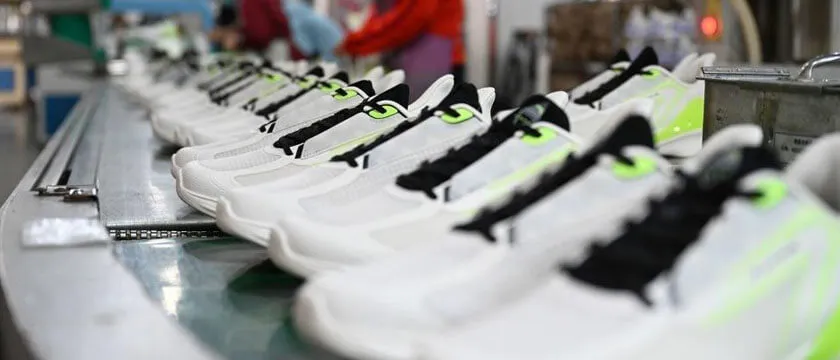
In a town of less than 40 square kilometers, more than 7,000 shoe companies and their suppliers produce over a billion pairs of sports shoes a year. Xinhua’s calculation: one in every five sports shoes worn on Earth comes from Chendai, a single town in Jinjiang, Fujian.
The Cluster by the Numbers
Jinjiang—under Quanzhou’s administration—carries the official title “China’s Shoe Capital” (中国鞋都). According to Xinhua and Fujian provincial industry data:
- Chendai town alone produces 1+ billion pairs of sports shoes annually, with an industry cluster worth ¥50+ billion and exports exceeding ¥18 billion.
- At the Jinjiang city level, the figures grow to 12 billion pairs a year—about 20% of global production—with 7,000+ shoe enterprises and supporting businesses.
- The cluster is home to Anta, Xtep, 361°, Hongxing Erke, and Peak—brands that grew from family workshops into national champions. Anta’s 2024 revenue of ¥70.8 billion made it China’s #1 sportswear group for the third consecutive year.
- Quanzhou’s modern sports products cluster—Jinjiang at its core—was selected as a national advanced manufacturing cluster, with output value exceeding ¥800 billion.
The 50-Kilometer Supply Chain
Jinjiang’s moat is not labor cost—it is the densest footwear supply chain on the planet. Local industry researchers describe it plainly: within a 50-kilometer radius, you can source every input for a sneaker—uppers, midsoles (EVA and foamed compounds), outsoles, laces, eyelets, lasts, and shoe machinery—within three days. Fujian provincial data counts more than 100 production stages executable inside this radius.
For buyers, this means development speed that Southeast Asian factories cannot match: a new sneaker style from design confirmation to sample pairs in two to three weeks, and material substitutions mid-production without container delays.
What Global Buyers Source Here
While the famous brands serve the domestic market, a deep tier of OEM/ODM factories produces for overseas retailers and D2C brands:
- Running and training shoes: The cluster’s volume core, with mature EVA/TPU midsole ecosystems.
- Basketball and court shoes: Higher spec, smaller runs—where Jinjiang’s material labs add value.
- Casual sneakers and athleisure: Fast-fashion friendly, with flexible MOQs driven by intense factory competition.
- Team and promotional footwear: Aggressive pricing tiers for institutional buyers.
Sourcing Reality Check
Jinjiang factories are brand-savvy and margin-aware—this is not a bargain basement. To succeed:
- Come with a defined spec sheet. Vague “quality sneaker” briefs get quoted at brand-OEM prices. Specify upper material, midsole compound, outsole type, and target test standard (SATRA or brand-equivalent).
- Expect MOQs of 1,000–3,000 pairs per colorway at serious factories; below that, you’ll be routed to trading companies.
- Verify social compliance. Large Western retail programs require BSCI/Sedex audits—confirm the factory holds current audits before sampling.
When to Visit
The annual Jinjiang footwear expos in spring bring the cluster together, and the Canton Fair phases (April/October) host Jinjiang exhibitors in Guangzhou. Allow three days on the ground: Chendai for factories, Quanzhou city for materials markets.
Ready to source athletic footwear from Jinjiang? Explore the Jinjiang activewear cluster, browse activewear & sportswear products, or Submit your RFQ to get matched with audited shoe factories.