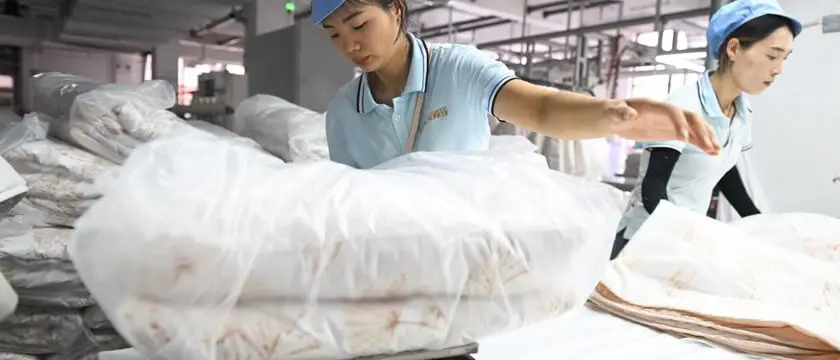
CCTV ran the numbers in a village feature and arrived at a sentence that should stop every bedding buyer: more than half of the world’s four-piece bedding sets are produced in one corner of Jiangsu. That corner is Nantong—specifically the towns around the Dieshiqiao market in Haimen—and the scale behind the claim is real.
The Numbers
Per Nantong industry park officials and Jiangsu media:
- The market and surrounding region produce over 12 billion home textile pieces a year, with combined market turnover at Dieshiqiao and Zhihao exceeding ¥240 billion in 2023.
- The cluster counts 38,500+ market entities and 500,000+ workers, with output reaching 1,350 duvet-cover sets per minute at peak.
- Foreign trade exceeds ¥30 billion annually, shipping to 150+ countries, while online merchants number 50,000+ and account for an estimated 70% of China’s online home textile sales.
- Nantong’s textile lineage runs deep: industrialist Zhang Jian opened the Dasheng Cotton Mill here in 1895, and the modern cluster grew from village embroidery workshops in the 1970s–80s.
Two mega-markets anchor the belt: Dieshiqiao International Home Textile City (finished goods) and Zhihao Fabric Market (fabrics and materials)—together the world’s largest home textile trading floor, where major brands like Luolai were born.
Why Speed Defines This Cluster
The Nantong ecosystem’s signature is its 24-hour cycle. Local merchants describe it plainly: every material and process needed for a bedding product—fabrics, printing, embroidery, filling, stitching—can be assembled in a single day within the cluster, with finished goods shipping the next day. Park officials credit this density for the cluster’s unmatched response to fast-moving e-commerce demand.
For cross-border sellers, this translates into small-batch, rapid-refresh programs that no other textile region can execute at comparable cost: test a design with 200 sets, reorder winners within the week.
What to Source
- Bedding sets: The volume core—sheet sets, duvet covers, pillowcases across cotton, Tencel/Lyocell, microfiber, and blends.
- Quilts and pillows: Down and down-alternative fills; check fill weights and cleanliness ratings (oxygen index) carefully.
- Functional lines: Cooling fabrics, antimicrobial finishes, and weighted blankets are the cluster’s current growth segments.
Quality Playbook
- Verify fabric specs against samples, not swatch cards. Thread count inflation is endemic industry-wide; GSM (grams per square meter) and fiber content from third-party tests are the honest metrics.
- Compliance for your market: OEKO-TEX Standard 100 for chemical safety is the baseline European retailers expect; US buyers should demand CPSIA-compliant labeling for children’s bedding.
- Mind the tier spread. From 5,000-unit factory lines to village workshops, quality variance is huge—audit before committing, especially on filled products where hidden fill substitutions occur.
When to Visit
Dieshiqiao is a working market every day of the year—buyers walk the trading floors year-round. The cluster’s spring and autumn expo periods concentrate new-season ranges and are the best windows for assortment planning.
Ready to source bedding from Nantong? Explore the Nantong home textiles cluster to map the supply chain, or Submit your RFQ to get matched with audited home textile factories.