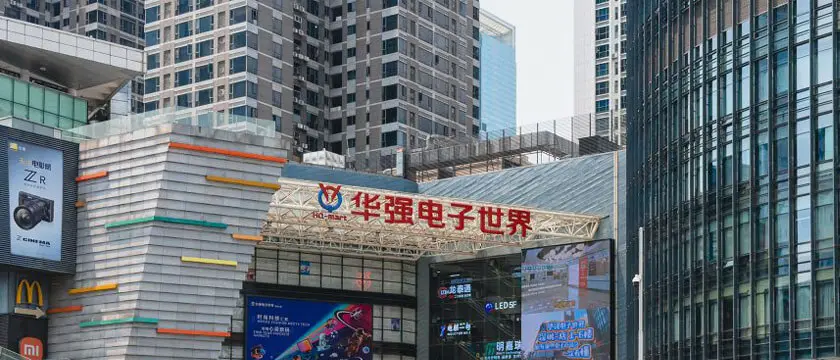
There is a phrase repeated so often in Shenzhen that it has become the district’s unofficial motto: “design in the morning, prototype in the afternoon, mass-produce tomorrow.” Huaqiangbei, the roughly one-square-kilometer electronics district in the heart of Shenzhen, is the densest hardware ecosystem on Earth—and the reason global startups, brands, and Fortune 500 R&D teams keep product development programs there.
The Numbers
- 1,000,000+ types of electronic components available within the district, per Xinhua’s 2026 coverage of the market.
- ¥50+ billion in smart-hardware output in 2023, with 20,000+ hardware entrepreneurs active in the ecosystem, per Shenzhen commerce data cited in Chinese media.
- Component procurement efficiency is reported to run about five times faster than the national average, with product development cycles compressed to a quarter of typical industry timelines—per multiple Chinese industry reports quoting local government data.
- In 2026, Huaqiangbei’s overall revenue grew 35% year on year, with AI glasses sales doubling and drone/robotics categories up 60–70%, per Southern Daily reporting.
Forty-Five Years of Stack Accumulation
Huaqiangbei began as a supply node for Shenzhen’s first electronics factories in the early 1980s. What makes it irreplaceable today is not any single market but the vertical stack compressed into walking distance: chip distributors, PCB fab houses, connector and cable suppliers, battery makers, industrial-design studios, assembly lines, test labs, and packaging suppliers—all inside one district.
That density changes the economics of hardware. A startup needing a custom sensor board can pick components at a stall in the morning, have PCBs fabricated across the street by afternoon, and hand-assembled units tested by the next day. Iteration cycles measured in weeks elsewhere happen in days here.
The ecosystem has also matured beyond trading. HAX, one of the world’s best-known hardware accelerators, relocated its headquarters into the district, citing that it has incubated 300+ hardware startups including Makeblock and Yeelight. Hardware “one-person companies” (OPCs)—solo founders running million-dollar product lines with Shenzhen’s contract manufacturing behind them—now number 500+, per Chinese media reporting. The district is also investing in AI-compute infrastructure, with roughly 14,000 P of computing power supporting local AI-hardware development.
For foreign teams, the practical effect is that the district now offers an English-friendly services layer—sourcing agents, design-for-manufacturing consultancies, compliance labs, and IP counsel—that did not exist a decade ago. A startup can land at Shenzhen Bao’an Airport and, without Mandarin, run a full prototype-and-quote cycle within a single week.
The Honest Caveats
Huaqiangbei’s reputation cuts both ways. The “shanzhai” (knockoff) era left a global impression that persists, and buyers still encounter gray-market components, refurbished chips sold as new, and IP-risky reference designs. The district’s trading floors are also famously fragmented—thousands of stalls, enormous variance in reliability. Sourcing here rewards buyers who do factory-level verification, treat ultra-low quotes as a signal rather than a bargain, and separate “market shopping” from “manufacturing partnership.”
What Global Buyers Source Here
- Rapid prototyping and NPI: PCBA, custom sensor modules, and pilot runs for IoT, wearables, and smart-home devices.
- Component consolidation: hard-to-find ICs, displays, batteries, and connectors aggregated across hundreds of distributors.
- AI and robotics hardware: the district’s fastest-growing categories—AI glasses, drones, service robots.
- OEM/ODM electronics: finished-device manufacturing through Shenzhen’s surrounding factory network, anchored by Huaqiangbei’s supply chain.
Sourcing Playbook
- Prototype in the district, manufacture in the network. Use Huaqiangbei for speed; place volume orders with audited factories in Shenzhen’s industrial belts (Bao’an, Longhua, Dongguan next door).
- Verify chips through authorized channels. For automotive, medical, or safety-critical parts, buy through franchise distributors, not open-market stalls.
- Protect your IP deliberately. Use NDAs with assembly partners, segment your BOM across suppliers where possible, and register designs in China before tooling.
- Engage the accelerator layer. HAX and district incubators can shortcut supplier introductions for foreign teams without local networks.
The corridor effect extends the ecosystem further: Dongguan’s factory belt begins within an hour’s drive, so a Huaqiangbei prototype can graduate to pilot production without relocating a single supplier relationship—an end-to-end path no other hardware hub in the world offers at comparable cost.
Ready to build smart hardware in Shenzhen? Explore the Shenzhen smart hardware cluster, or Submit your RFQ to get matched with vetted electronics manufacturers.