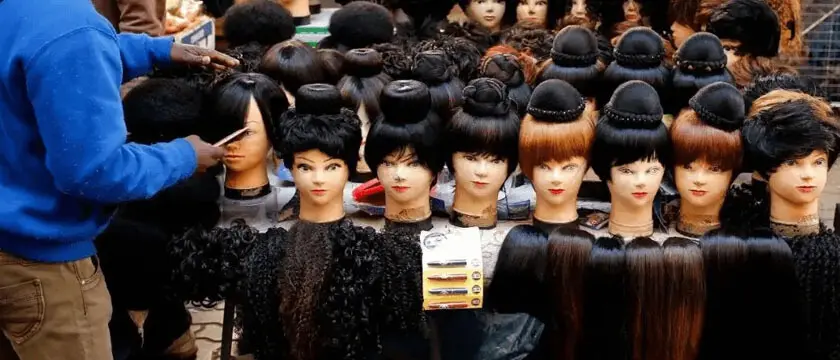
Xuchang, a prefecture-level city in Henan province, is statistically the single most likely origin of any wig worn anywhere on Earth. Xinhua has reported the figure repeatedly: six out of every ten wigs produced worldwide are made in Xuchang. The city holds over 60% of global production, more than 40% of the European and American markets, and around 70% of the African market, per local industry data cited in Chinese state media.
The Numbers
- 4,000+ hair-product enterprises employing around 300,000 people—roughly one in fifteen of the city’s residents works in the industry, per Xinhua’s 2024 coverage.
- 2023 trade of ¥19.69 billion, including ¥16.85 billion in exports—hair products accounted for about 71% of Xuchang’s total exports that year, per customs data reported by state media.
- The momentum continued: per Qingdao Customs data cited in 2026 reporting, Xuchang’s hair-product trade reached ¥21.91 billion in 2025, with exports of ¥17.2 billion—around half of China’s total hair-product exports.
- 3,000+ product varieties across six major categories (lace fronts, machine-made wefts, toupees, braids, extensions, and accessories), shipping to 120+ countries.
- 3,000+ cross-border e-commerce sellers operate from Xuchang, with cross-border platforms describing an order shipped “every two seconds” from the city.
Five Centuries of Hair Trading
Xuchang’s hair trade began in the Jiajing era of the Ming dynasty (16th century), when traders in Lingjing Town started collecting and sorting raw human hair. The first formal “hair trading house” opened around 1900, and the modern industry emerged in the reform era when factories began processing hair into finished products rather than exporting raw material.
The cluster’s listed champion is Rebecca (Xuchang Rebecca Hair Products), China’s first publicly listed hair-product company, which has built overseas factories in Nigeria, Ghana, and Cambodia to serve African and global markets from inside the demand regions. Around it sits a deep bench of mid-size factories and thousands of family workshops handling knotting, ventilating, dyeing, and finishing.
Why the World Sources Hair Here
The moat is labor skill. Hand-knotting a lace-front wig onto a cap is work that has resisted full automation: a skilled ventilator spends days on a single unit. Xuchang has concentrated that skill at industrial scale—what took centuries to accumulate is not easily replicated elsewhere. The city pairs it with complete downstream capability: acid-free bleaching and dyeing (the hardest step to do well), lace customization, and QC departments fluent in U.S. and African market standards.
For African-market products in particular, Xuchang’s advantage is unmatched—local manufacturers understand curl patterns, lace tones, and style preferences at a depth no competing region matches, and the cross-border e-commerce layer means a single Xuchang partner can handle everything from factory floor to last-mile fulfillment on Jumia or TikTok Shop.
The workforce figure tells the scale of that advantage: with around 300,000 people employed across 4,000+ enterprises, Xuchang can absorb large program orders and seasonal surges that would strain any competing base—one reason global brands increasingly run their entire hair category through a single Xuchang supply partner rather than splitting orders across countries.
What Global Buyers Source Here
- Lace-front and full-lace wigs: the premium line, custom knotting and hairline design at factory-direct pricing.
- Machine-made wigs and wefts: volume categories for retail chains and e-commerce brands.
- Hair extensions and braiding products: bundles, closures, and bulk hair in Remy and virgin grades.
- Men’s toupees and medical wigs: a growing niche served by several specialist factories.
- Private-label programs: MOQs are famously flexible—many factories accept trial orders of a few dozen units.
Sourcing Playbook
- Specify hair grade precisely. “Virgin,” “Remy,” and “non-Remy” carry vastly different prices; reputable factories will explain sourcing and offer burn tests or cuticle checks.
- Separate retail from wholesale suppliers. The 3,000+ e-commerce sellers and the 4,000+ factories overlap but are not the same list—brand buyers should go factory-direct; dropshippers may prefer trading companies with overseas warehouses.
- Verify export-market experience. U.S.-bound product involves FDA-adjacent labeling and tariff questions; established exporters will already have documentation routines.
- Visit during the hair expo. Xuchang hosts China’s main hair-products trade fair, the industry’s best single-visit sourcing window.
Ready to source wigs and hair products from Xuchang? Explore the Xuchang human hair cluster, or Submit your RFQ to get matched with vetted hair manufacturers.