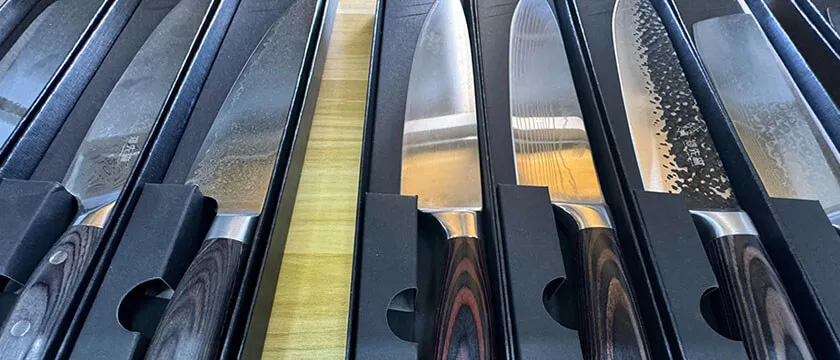
Yangjiang’s blade-making tradition dates to 557 AD, when regional legend Xian Furen stationed troops here and weapon-crafting skills passed to civilian smiths. Sixteen centuries later, the city holds the modern title “China’s Knife & Scissors Capital” (中国刀剪之都)—and a supply-chain dominance no other blade region on Earth approaches.
The Dominance, in Data
Per the People’s Daily (January 2025) and Yangjiang’s industry bureau:
- Yangjiang produces 75% of China’s knives and scissors and 85% of China’s knife exports—local officials compress this into a slogan: “seven of every ten knives made in China come from Yangjiang.”
- The full industry chain exceeded ¥55 billion in 2024, with 2,000+ manufacturers, 8,500+ related business entities, and ~200,000 workers.
- Product range spans 5,000+ types: kitchen knives, household scissors, manicure sets, BBQ tools, ceramic knives, and industrial blades, exported to 130–160+ countries and regions.
- The cluster holds the three great Chinese blade brands under one prefecture: Shibazi (十八子, local born), Wangmazi (王麻子, acquired by Yangjiang’s Jinhui in 2020), and Zhang Xiaoquan (张小泉, which built a smart manufacturing base here). International reports also note German premium brands have operated OEM arrangements in the city.
- “Yangjiang Hardware & Knife-Scissors” was selected for the first national list of China Consumer Famous Brands (regional brands) published by the Ministry of Industry and Information Technology in 2024.
A 30-Process Cluster
A quality knife passes through 30+ operations: steel selection, stamping or forging, heat treatment, grinding, polishing, handle fitting, edge honing. In Yangjiang, each of those processes has dedicated specialist suppliers—heat treatment shops, CNC grinding houses, handle makers, and packaging printers—so factories assemble final product from a deep local bench. This is why a custom knife project here can move from drawing to sample in two weeks.
The city’s quality infrastructure is unusually deep for a mid-tier city: a customs-run national food-contact material testing lab, CNAS-accredited laboratories, and AEO-certified exporters that clear customs fast.
Sourcing Playbook
- Specify the steel, not just “stainless.” The difference between a ¥3 knife and a ¥30 knife is largely steel grade and heat treatment. Common spec language: 3Cr13 (budget), 5Cr15MoV (mid-range workhorse), or VG-10-layered steels (premium). Request the material cert and HRC hardness range (typically 54–58 HRC for kitchen knives).
- Food-contact compliance: For US and EU kitchenware, demand FDA or EU 1935/2004 food-contact test reports—the local customs lab can produce these.
- Brand vs. OEM tiers: The famous brands command brand pricing. For private-label value, the OEM tier below them delivers near-identical manufacturing with far more flexible terms.
- Ceramic and titanium lines: Growing specialty segments where Yangjiang’s material shops have invested heavily.
When to Visit
The China (Yangjiang) International Hardware Knife & Scissors Expo—held annually for over two decades, most recently its 24th edition in 2025—is one of the world’s few blade-specific trade fairs. Two factory days in Yangdong district, where Shibazi and Jinhui anchor a kilometers-long manufacturing strip, completes the trip.
Ready to source knives and kitchenware from Yangjiang? Explore the Yangjiang kitchen hardware cluster, browse home & kitchen hardware products, or Submit your RFQ to get matched with audited factories.