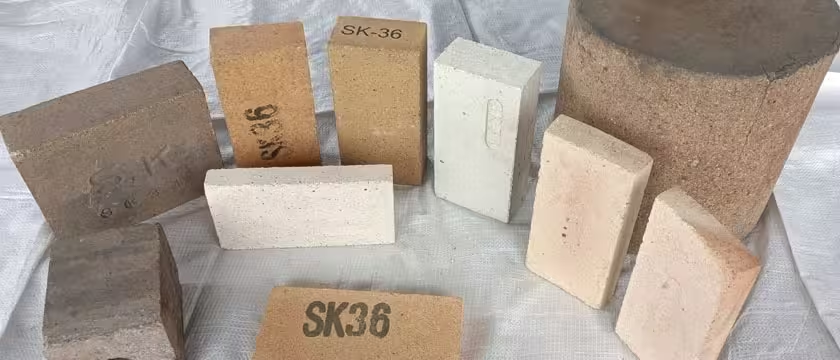
Refractories are the industrial category your spreadsheet thinks it understands and doesn’t: the unit is the ton, the MOQ is the truckload, and the product is a chemistry decision before it is a purchasing decision. Our October 2026 sampling across five refractory classes puts reference bands on the full ladder:
| Product Class | Reference Range | Unit | Band Logic |
|---|---|---|---|
| Acid-Resistant Fireclay Bricks | 50 – 690 | ton | Standard SK30–SK34 grades at full-truckload volume; high-duty, low-porosity or glazed grades in small lots at the top |
| High Alumina Bricks (Rotary Kilns) | 150 – 800 | ton | Standard 48–65% Al₂O₃ grades in volume; 75–85% dense or shaped (arch/wedge) bricks in small lots at the top |
| Lightweight Mullite Insulating Bricks | 230 – 1,000 | ton | JM23 standard grades in volume; JM28–JM30 high-temperature or custom-shaped bricks at the top |
| Magnesia-Carbon Bricks (Steel Ladles) | 400 – 1,750 | ton | Standard MT12–MT14 slag-zone grades; high-purity fused-magnesia MT16–MT18 with antioxidants at the top |
| Silicon Carbide Kiln Plates | 1.00 – 130.00 | piece | Small oxide-bonded shelves in volume; large recrystallized or nitride-bonded shelves in small lots at the top |
Price data source: publicly listed wholesale prices on mainstream B2B platforms, collected on 2026-10-19. These are reference ranges only — actual transaction prices vary significantly with order quantity and customization requirements. For full methodology, see Understanding Reference Prices.
Reading 1: The Chemistry Ladder Is the Price Ladder
Lay the four per-ton bands side by side and they form a near-monotonic chemistry staircase:
- Fireclay ($50–690/ton): the commodity base — aluminosilicate chemistry for chimneys, boilers, and general furnace lining.
- High alumina ($150–800/ton): rising Al₂O₃ content buys refractoriness under load; the band top belongs to 75–85% dense grades and shaped arch/wedge bricks for rotary kilns.
- Mullite insulating ($230–1,000/ton): you are paying for the opposite of density — engineered porosity that insulates, graded by the JM system (JM23 at the floor, JM28–JM30 at the top).
- Magnesia-carbon ($400–1,750/ton): the steel-ladle workhorse, graded by the MT system; the top of the band is fused-magnesia MT16–MT18 chemistry with antioxidant packages.
For buyers, the lesson is that grade suffixes — SK, JM, MT — are not catalog trivia. Each step within a grade system moves you measurably along that product’s own price band.
Reading 2: Volume Structure Resets Expectations
Refractory trades at MOQs of 1–25 tons, and the band floors are explicitly full-truckload pricing: the $50/ton fireclay anchor corresponded to bulk volume, while one-ton lots of the same family ran $120–350. If your maintenance project needs three tons, budget the middle of the band, not its floor — and know that the quote step between one truck and five is where the real negotiation lives.
Reading 3: Freight Is the Hidden Second Invoice
A category priced at $50–200 per ton ships at densities that make ocean and rail freight a first-order cost. On low-end fireclay, total landed cost can exceed the ex-works material cost — a structural reality, not a supplier failure. The bands above are ex-factory-style figures excluding shipping and duties; for refractories more than any category in our dataset, request CIF/DAP quotations early, and treat two quotes as comparable only at matched Incoterms.
Reading 4: The Per-Piece Outlier — SiC Kiln Plates
The silicon carbide band is priced per piece and spans 130× — because “SiC plate” covers three generations of bonding technology. Oxide-bonded shelves in volume ran $1–5 per piece; nitride-bonded around $4–6; recrystallized 1,400°C-grade plates at $18–23 (MOQ 100); and small-lot premium listings reached $129 per plate. Bonding method, working temperature, and lot size — in that order — explain the spread. Comparing SiC quotes without the bonding method named is the same error as comparing fireclay per-ton numbers without the SK grade.
Traps the Sampling Surfaceed
- Decorative brick confusion. Building-aisle “acid-resistant” tiles at $7.2–15/m² share keywords with industrial fireclay at $50–690/ton. Different products, different aisles, different failure consequences.
- Sample fees masquerading as prices. A $1,299 “listing” in the SiC search was a sample charge, not a unit price — excluded, and worth remembering whenever a refractory number looks implausibly high.
- Unit mixing. Per-piece, per-square-meter, and per-ton listings interleave in search results; fireclay alone appeared in all three. Lock the unit before comparing anything.
Buying Guidance
- General furnace/chimney maintenance: fireclay at volume, SK30–34, against the $50–250 mid-low band.
- Cement rotary kilns: high-alumina shaped bricks, budget $500–800 for dense/small-lot tiers.
- Steel ladle slag zones: magnesia-carbon MT12–14 at $400–800; MT16–18 high-purity only where slag chemistry demands it — at $1,500–1,750, it is a metallurgical decision, not a purchasing one.
- Ceramic kiln furniture: SiC shelves by bonding method — oxide-bonded for cost, recrystallized for temperature.
Caveats
All figures are ex-factory-style listing prices excluding shipping, duties, and inspection. Refractory input costs (magnesia, alumina, SiC) are commodity-linked and these bands should be re-validated within one to two quarters — sooner if your program is magnesia-based.
Related products: High Alumina Refractory Bricks for Rotary Kilns · Magnesia Carbon Bricks for Steel Ladles · Silicon Carbide Refractory Plates for Ceramic Kilns
Methodology: Understanding Reference Prices on Product Pages
Ready to move from reference ranges to binding quotes? Submit an RFQ with your grade, application temperature, and tonnage — and compare written quotations against the bands above.