Nearly every pre-shipment inspection report from China references AQL, the acceptance quality limit system defined in ISO 2859-1 (harmonized in North America as ANSI/ASQ Z1.4, both descended from the older MIL-STD-105E). Yet many buyers sign off on reports they cannot actually read. This guide decodes the system in the five minutes it takes to understand a report.
What AQL Actually Means
AQL is not “maximum percent defective allowed in your lot.” Formally, it is the worst tolerable process average—the quality level a supplier’s ongoing production must achieve for lots to be accepted routinely, per ISO 2859-1’s definition. In practice, for a single inspection, the AQL converts into two numbers: an acceptance number (Ac)—defects at or below it, the lot passes—and a rejection number (Re)—defects at or above it, the lot fails.
AQL 2.5, the most common value in consumer goods, does not mean “2.5% defective is fine.” It means the sampling plan is calibrated so that a supplier consistently producing 2.5% defective will pass most lots—while a supplier doing substantially worse will fail most.
How the Sample Size Gets Picked
The standard uses two inputs: your lot size (total units in the order) and an inspection level. The default is General Inspection Level II; Level I uses smaller samples (cheaper, less discrimination) and Level III larger ones. Special levels S-1 to S-4 exist for destructive or expensive tests.
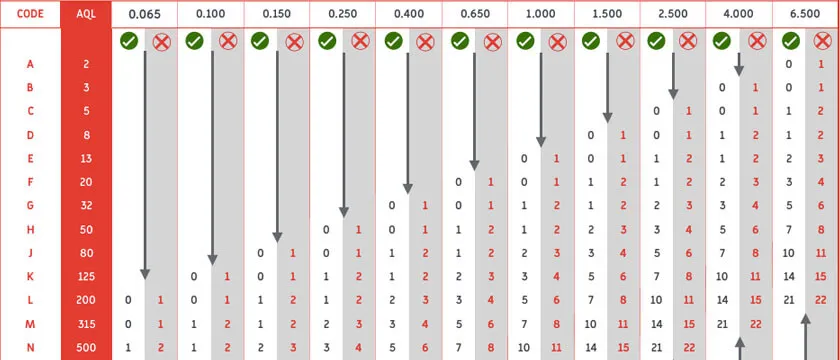
Lot size plus level yields a code letter, and the code letter yields the sample size. At Level II, per the standard’s master tables:
| Lot size | Code letter | Sample size |
|---|---|---|
| 281–500 | H | 50 |
| 501–1,200 | J | 80 |
| 1,201–3,200 | K | 125 |
| 3,201–10,000 | L | 200 |
| 10,001–35,000 | M | 315 |
The Standard Defect Structure
Professional inspections classify defects into three classes with separate AQLs:
- Critical (AQL 0): Safety hazards or regulatory failures—a loose part on a baby product, a short circuit. Any finding fails the lot; often these require 100% checking rather than sampling.
- Major (AQL 1.0–2.5): The product does not function or cannot be sold as first quality.
- Minor (AQL 2.5–4.0, sometimes 6.5): Cosmetic imperfections that do not affect function.
Reading a result line is then mechanical. Example: a 5,000-unit lot is code L at Level II—sample 200 units. At AQL 2.5 the table gives Ac 10 / Re 11: ten or fewer major defects passes; eleven or more fails. At AQL 4.0 the same sample passes at 14 and fails at 15.
The Three Traps in Real Reports
- “Passed at AQL 2.5” with critical defects noted in remarks. Critical defects are not governed by AQL sampling—they are automatic failures. Some factories pressure inspectors to reclassify criticals as majors. Never accept that.
- Wrong inspection level. A supplier proposing Level I halves the sample and weakens your protection. Unless you have a multi-year clean record with this factory, hold Level II.
- No defect taxonomy in the PO. If your purchase order does not define what counts as major versus minor for your product, the inspector decides on the day. Define the taxonomy in writing before production starts.
What to Do When a Lot Fails
ISO 2859-1 provides structured remedies: the lot can be screened 100%, reworked and re-inspected, or accepted by concession with a documented price adjustment. The standard’s switching rules also matter long-term—repeatedly rejected lots trigger tightened inspection for subsequent orders, which is exactly the leverage you want over a drifting supplier.
One nuance buyers miss: the switching rules cut both ways. Ten consecutive accepted lots earn the supplier reduced inspection—smaller samples, lower cost—which is a legitimate reward to negotiate for, and one worth mentioning during price discussions. Inspection cost scales with sample size, so a demonstrated quality history has real monetary value on both sides of the table.
Don’t want to decode reports alone? Submit your RFQ and work with manufacturers whose inspection records are verified—so the report you read matches the factory you audited.