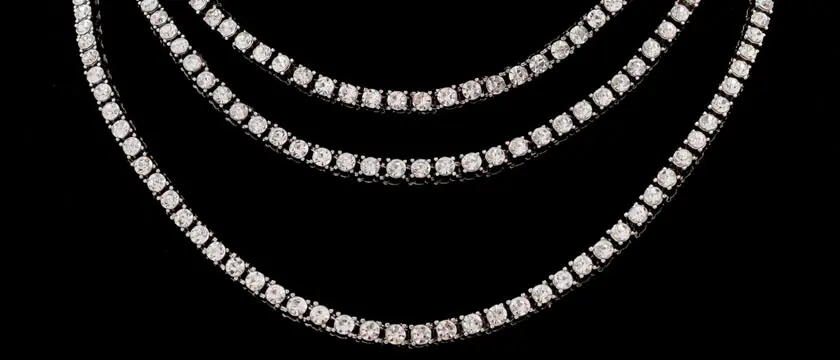
Two cubic zirconia tennis necklaces can look identical in a product photo and still be five price tiers apart. Our October 2026 sampling of mainstream B2B platforms put the reference band at $5.00 – $25.00 per piece — a 5× spread that, unlike the Cuban link chain’s width-driven range, comes from three stacked variables: base metal, stone count and size, and how the stones are attached.
Here is how to read each one before you order samples.
Price data source: publicly listed wholesale prices on mainstream B2B platforms (Alibaba.com, Made-in-China.com), collected on 2026-10-18. These are reference ranges only — actual transaction prices vary significantly with order quantity and customization requirements. For full methodology, see Understanding Reference Prices.
Driver 1: Base Metal — Brass vs 925 Sterling Silver
This is the single biggest line item. The low end of the band is brass-base CZ tennis chain; the high end is 925 sterling silver. The two materials behave very differently in the field:
- Brass + plating is the volume play — fine for fashion and occasion wear, but plating wear at skin contact points is a known return-driver.
- 925 silver costs materially more per gram and holds rhodium or gold plating far better, which is why bridal and premium fashion programs insist on it.
A $8 necklace quoted as “silver” deserves scrutiny: many listings mean silver-plated brass. If the base matters to your brand, specify “925 sterling silver, stamped” in writing and budget for the upper band.
Driver 2: Stone Size and Count — the Math Hiding in the Spec Sheet
Standard configurations run 2 mm to 5 mm stones, roughly 40–80 stones per necklace depending on length (3 mm on an 18-inch chain is the common middle). The cost arithmetic is unforgiving:
- A 5 mm stone weighs roughly 15× what a 2 mm stone does (gem weight scales with the cube of diameter), so stone cost jumps far faster than the millimeter number suggests.
- An 80-stone, 24-inch piece has double the setting labor of a 40-stone, 16-inch piece.
So when Supplier A quotes $6 and Supplier B quotes $14 “for the same necklace,” the first reconciliation step is stone diameter, stone count, and chain length on both spec sheets. In this product, mismatched stone specs — not margin — explain most quote gaps.
Driver 3: Setting Method — Hand-Set Prongs vs Glue
The quality fault line in CZ tennis chains is not the stone; it is what holds it. The band’s upper half corresponds to hand-set 4-prong (or 3-prong) settings with no glue — each stone individually seated by a setter. The lower end of the market quietly substitutes glue-set or cast-in stones, which pass a photo inspection and fail within weeks of wear: stones cloud, fall out, and reviews collapse.
This is the one spec you should never negotiate downward. “Hand-set, prong-set, no glue” belongs in your purchase order in those words.
The Details That Round Out the Quote
- Clasp: the standard at the upper end is a hidden double-safety box clasp. Cheap listings substitute lighter single-latch clasps that open under tension — a classic “necklace lost at a wedding” complaint.
- Plating finish: rhodium (silver tone) or 18K gold plating over the base metal; specify plating thickness targets if your market runs warm and humid.
- Stone grade: AAAA/AAAAA-grade CZ is the listing norm in this band; below that, brilliance drops visibly under store lighting.
Reading the Band by Business Model
- Occasion/fashion retail, price-led: brass base, 2–3 mm stones, 16–18 inch lengths — $5–9 zone. Accept shorter plating life, brand the packaging instead.
- Core assortment / DTC brand: brass or silver-fill positioning with 3 mm stones, hand-set prongs, hidden box clasp — plan $10–16.
- Bridal / premium: 925 silver, 3–5 mm, full hand-setting and double-safety clasp — the $18–25 end of the band, where returns risk is lowest and margin defense is highest.
Red Flags Within the Band
- Stone count absent from the quotation. “Tennis necklace $7/pc” without stone diameter and count is not a price — it is an invitation to a renegotiation.
- Glue-set at a hand-set price. Ask for a macro photo of the setting backs, or better, a stone-pull test protocol in your QC plan.
- “Silver” without a stamp spec. Insist on 925 stamping and, for volume programs, third-party composition assay on the first article.
MOQ and Exclusions
As with all Indexfox reference prices, the $5–25 band is an ex-factory-style unit figure at standard MOQ tiers, excluding shipping and duties, custom clasp/logo tooling, samples, and third-party inspection. Stone markets and metal prices drift, so treat October 2026 figures as orientation and re-validate if your PO lands more than two quarters out.
Related products: CZ Tennis Necklaces · Herringbone Snake Chains · Engravable Bar Pendants
Methodology: Understanding Reference Prices on Product Pages
Ready to move from reference ranges to binding quotes? Submit an RFQ with your base metal, stone size, stone count, length, and target quantity — and compare written quotations against the band above.