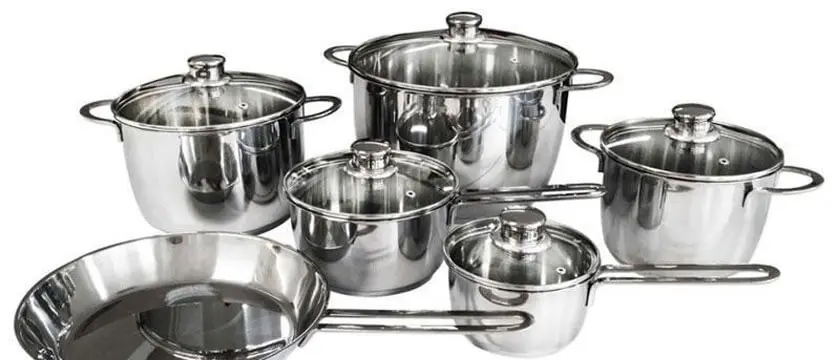
“Food-grade stainless steel” is one of the most abused phrases in cookware sourcing. In practice it means two separate things that suppliers happily blur: the steel’s corrosion resistance in food contact, and legal compliance with migration limits. A pot can be genuinely 304 and still fail food-contact regulation, and a 430 pot can be perfectly legal. Here is how to buy the distinction intelligently.
The Materials, Honestly
304 (18/8 or 18/10 austenitic): roughly 18% chromium and 8–10.5% nickel, per the ASTM A240 composition specification. Non-magnetic (or nearly so) in finished form, excellent corrosion resistance, the default for premium cookware bodies, inner pots, and anything touching acidic food long-term. Costs more, both in raw material and because it work-hardens during stamping.
430 (18/0 ferritic): 16–18% chromium, no nickel. Magnetic, corrosion resistance adequate for many kitchen uses but inferior in salt and acid environments, less ductile for deep drawing. It is roughly 30–50% cheaper than 304, which is why it dominates flatware, mixing bowls, outer pot walls of budget cookware, and induction-compatible bases.
The classic legitimate construction: a 430 magnetic outer layer (for induction) bonded to a 304 cooking surface. The classic illegitimate construction: an all-430 pot sold as “food-grade 304.”
The Regulatory Layer: GB 4806.9-2023
For product made or sold in China, the controlling food-contact standard is GB 4806.9-2023, “National Food Safety Standard for Metal Materials and Articles in Contact with Foodstuffs,” which took effect on September 6, 2024, replacing the 2016 edition. Buyers should care about three of its changes:
- Expanded migration testing: the new version moves beyond the five heavy metals of the 2016 edition to 13 tested elements—four impurity elements (arsenic, cadmium, lead, mercury) plus nine alloying elements (including chromium, nickel, aluminum, and manganese), tested per GB 31604.49.
- Stricter raw-material rules: lead, cadmium, arsenic, mercury, antimony, beryllium, and lithium may not be used as alloying elements in food-contact base materials and coatings.
- Repeat-use testing: products intended for repeated use are migration-tested three times, with any single exceedance failing the product.
Two practical consequences. First, a supplier’s old GB 4806.9-2016 report is no longer sufficient for current compliance—the transition ended with the new edition’s effective date. Second, “food grade” in a quotation is not a compliance claim; only a test report against the 2023 standard from a qualified (CMA-accredited) lab is.
For export markets, layer your destination’s regime on top: EU buyers typically reference Regulation (EC) No 1935/2004 with German LFGB testing as the de facto benchmark, U.S. buyers the FDA’s 21 CFR food-contact provisions. A factory serving both will hold both GB and LFGB/FDA test reports—ask for the destination-relevant one.
Telling 304 from 430 on the Buying Desk
- Magnet test: a strong magnet grips 430 and slides off annealed 304. Two minutes with a neodymium magnet catches most substitutions on incoming inspection. Caveat: cold-worked 304 can pick up slight magnetism at bends, so a positive magnet response near an edge is not conclusive—on a flat wall, it is.
- XRF spectrometer: any third-party lab or serious factory QC room can read alloy composition in minutes. For program volumes, require a material test report per production lot—cheap insurance against a factory quietly downgrading to 430 mid-contract.
- Price sanity: if a “304” quote sits at the 430 price level, the material is not 304. Nickel is the cost driver, and it is not subtle.
Which Grade for Which Product
| Application | Recommended grade | Why |
|---|---|---|
| Pot/pan cooking surfaces, acidic food contact | 304 | Corrosion resistance where it matters |
| Induction-compatible base layer | 430 (clad) | Magnetism plus cost |
| Flatware, serving bowls | 430 acceptable | Short contact, cost-driven |
| Deep-drawn premium cookware | 304 | Ductility; 430 cracks in deep draws |
| Budget stock pots | 430 body + 304 interior | Cost balance, honest spec |
The Sourcing Playbook
- Write the grade into the PO with the composition reference (e.g., “SUS 304, per GB/T 3280” or ASTM 304), not the word “food grade.”
- Request current GB 4806.9-2023 reports from a CMA-accredited lab, matched to the finished product—not raw material certificates alone.
- Add destination-market tests (LFGB, FDA) for export SKUs.
- Reserve lot-level XRF verification for first orders and for any supplier whose pricing looks too good.
Sourcing cookware from verified factories? Browse home and kitchen hardware manufacturers, or Submit your RFQ to get matched with suppliers holding current GB 4806.9-2023 test reports.