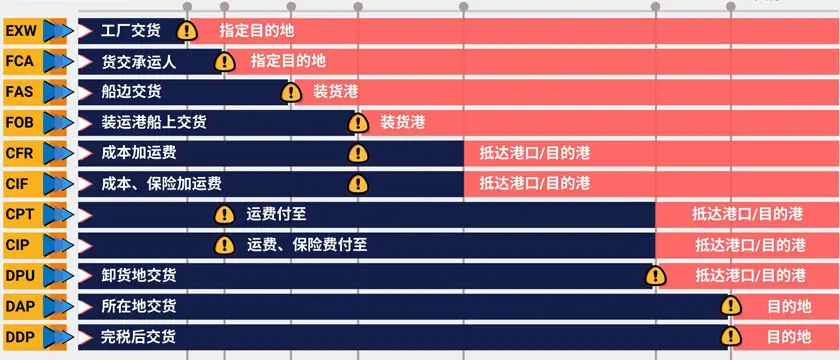
Incoterms—the International Chamber of Commerce’s standard trade terms, current version Incoterms 2020—decide who pays for transport, who clears customs, and most importantly, where risk transfers from seller to buyer. Chinese suppliers quote all eleven terms, but three dominate China trade: EXW, FOB, and DDP. Choosing wrong on a single clause can shift thousands of dollars of cost—or uninsured cargo risk—onto you without noticing.
The Landscape in 30 Seconds
Incoterms 2020 defines 11 rules in two groups: seven for any transport mode (EXW, FCA, CPT, CIP, DAP, DPU, DDP) and four for sea and inland waterway only (FAS, FOB, CFR, CIF). They range from minimum seller obligation (EXW) to maximum (DDP). What they never cover: payment terms, transfer of ownership, or breach remedies—those live in your sales contract.
EXW: Cheapest Quote, Most Hidden Work
Under Ex Works, the seller’s only job is to make goods available at their factory gate. The buyer arranges pickup, export clearance in China, main freight, insurance, and import clearance.
The catch: in practice, foreign buyers cannot clear Chinese export customs—export declaration requires a Chinese entity with export rights. Buyers quoting EXW end up paying a local agent to handle it, and sellers quoting EXW are often trading companies without export licenses. EXW also starts your insurance exposure at the factory gate, before any transit. Use EXW only with a freight forwarder experienced in China pickup, and price in the extra ¥1,000–3,000 of local handling it creates.
FOB: The China Standard (With a Container Caveat)
FOB—Free On Board—is the default of China manufacturing: the seller delivers goods on board the vessel at the named port of loading, clears export, and the buyer takes over ocean freight, insurance, and import.
It works well for conventional cargo. But there is a trap the ICC itself warns about: FOB is a sea-and-inland-waterway-only term whose risk point is “on board the vessel”—while containers are handed to the carrier at the container yard, often days before loading. If cargo is damaged in that gap, disputes arise over whose risk it was. For containerized shipments, the ICC recommends FCA (Free Carrier) instead: delivery happens when the container reaches the carrier at the yard, eliminating the gap. FCA also works for air and multimodal, where FOB is technically inapplicable.
In practice, “FOB port” remains the lingua franca of China trade and works fine when paired with clear documentation—but sophisticated buyers increasingly write FCA [container yard] into contracts and let their forwarder manage the difference.
DDP: Door-to-Door Simplicity, Real Compliance Risk
DDP—Delivered Duty Paid—puts everything on the seller: freight, insurance, import clearance, and duties, delivered to your door. For e-commerce sellers and first-time importers, it feels effortless.
The risks: first, your supplier (or their broker) becomes the importer of record in your country, which many suppliers cannot properly be—some misdeclare value or route through gray channels, and the compliance exposure can follow the buyer. Second, DDP quotes bake duties and fees into the product price with a markup you cannot audit. Third, if the DDP arrangement collapses mid-shipment, you may face storage fees at destination with no control of the customs file.
Use DDP only with suppliers who can document their IOR arrangements in your market, and always compare a DDP quote against an FOB quote plus your forwarder’s landed-cost estimate.
Choosing for Your Situation
- Experienced importer with a freight forwarder: FOB (or FCA for containers/air) is your default—maximum control, transparent freight costs.
- Small trial orders or samples: EXW with a China-based consolidator, or simply ask for FOB even on small lots.
- E-commerce restocking with no logistics team: DDP from a supplier with proven IOR capability in your market—verify, don’t assume.
- Letter-of-credit transactions: note that Incoterms 2020 added an FCA mechanism allowing an on-board bill of lading, fixing a long-standing conflict between FCA delivery and L/C documentation.
Whichever term you pick, name the place precisely (“FOB Ningbo”, not just “FOB”) and state “Incoterms 2020” in the contract—otherwise you may inherit an older version’s risk allocation by default.
Ready to ship with terms that protect you? Submit your RFQ and get quotes from manufacturers experienced in your preferred Incoterm—FOB, FCA, or documented DDP.