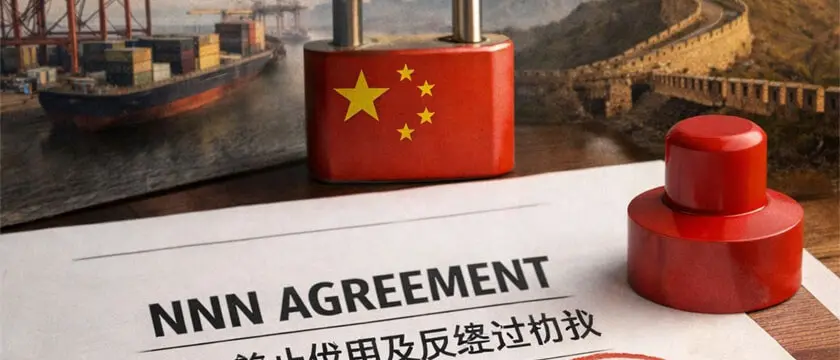
Here is a pattern that repeats every week in China sourcing: a buyer sends a factory a Western-style NDA, the factory signs it, and six months later a near-identical product appears on the market—sold by the factory’s other customer or by the factory itself. The buyer threatens legal action and discovers the NDA is nearly worthless in this scenario. Not because Chinese courts ignore contracts, but because a standard NDA was never designed for the threat model of manufacturing.
Why NDAs Fail in the Factory Context
A conventional NDA prohibits one thing: disclosing confidential information. Chinese manufacturers rarely leak your drawings to a third party. What they actually do falls outside the NDA’s text entirely:
- Use: Apply your design, molds, or specifications to produce the same product for other customers or their own brand. No “disclosure” occurs—the information never leaves the building—so no NDA breach occurred.
- Circumvention: Learn your end customers from the order, then approach them directly with a lower price, cutting you out of your own distribution.
This is why China-sourcing lawyers replaced the NDA with the NNN agreement, which adds the two missing prohibitions: non-use (the factory cannot use your information for any purpose other than your order) and non-circumvention (the factory cannot bypass you to deal with your customers or suppliers). The EU Intellectual Property Helpdesk’s official guidance on contract-based IP protection in China explicitly recommends this structure for manufacturing relationships.
What a Proper China NNN Contains
Beyond the three N’s, enforceability lives in the execution details:
- Governing law: PRC law. Foreign-law contracts are difficult or impossible to enforce in Chinese courts.
- Jurisdiction: a Chinese court or arbitration body (CIETAC, or local courts where the defendant is registered). A U.S. or EU jurisdiction clause is effectively decorative.
- Chinese as the controlling language. Courts work from the Chinese text; bilingual execution with Chinese precedence is standard practice. A translation error becomes a legal exposure.
- Official company chop. The contract must bear the company’s registered seal (公章), not merely a salesperson’s signature. A chop-less contract may not bind the company at all.
- Liquidated damages. Chinese contract law handles clearly specified breach penalties far better than open-ended damage claims. A fixed sum per breach—or per day of continuing breach—gives you a realistic recovery path and, more importantly, deterrent leverage.
- Defined confidential information. “All business information” invites disputes. Enumerate: drawings, CAD files, molds and tooling, pricing, customer lists, specifications.
- Audit rights. The right to inspect the factory verifies no unauthorized production line is running your tooling for someone else.
NNN Is Necessary, Not Sufficient
The NNN governs information. It does not replace registered IP. If your brand matters, file your trademark in China before manufacturing begins—China is a first-to-file jurisdiction, and factories have been known to register a foreign buyer’s mark and then negotiate. Design patents on distinctive product appearances are comparatively quick to obtain in China and pair well with NNN enforcement. And mold-ownership clauses should specify that tooling paid by you remains your property, removable on notice.
Layered properly: trademark registration + NNN agreement + mold-ownership clauses + supplier verification. Each layer covers a failure mode the others miss.
Enforcement Reality
An NNN’s practical value is leverage, not litigation. Chinese courts do enforce well-drafted contracts, and the standard playbook for suspected breach—documented evidence, a demand letter from local counsel, and where warranted, a civil claim or arbitration filing—resolves most disputes before judgment. Factories respond to credible legal standing because they know the buyer can act locally. The agreement converts a messy “they copied us” dispute into a clean contractual breach with a price attached.
Timing matters as much as drafting: sign the NNN before any technical file changes hands—ideally before the first detailed quotation, since even a quoted BOM can reveal cost structure a competitor would pay to learn. Retroactive protection, signed after samples circulate, is dramatically weaker in practice because proving what was confidential, and when, becomes the dispute itself.
Drafting costs are modest relative to exposure: budget for counsel experienced in Chinese contract law, not a repurposed Western template.
Ready to share designs with factories that respect them? Submit your RFQ and get matched with audited manufacturers accustomed to IP-protected programs—NNN agreements, mold-ownership clauses, and documented confidentiality workflows.