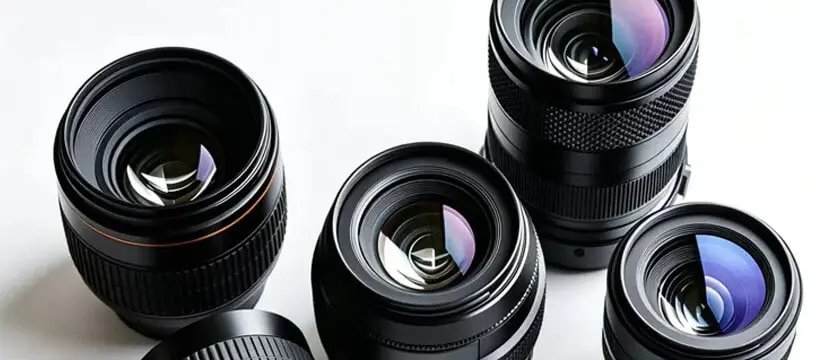
Optics is the least “list-price-friendly” category we have priced. A BK7 plano-convex lens lists from $0.58 to $22.00; a germanium infrared lens from $1.20 to $90.00. These are not supplier games — they are the visible seam between catalog optics and precision optics, both of which sell on the same B2B pages.
If your program involves laser systems, imaging, sensors, or watch/consumer optics, this guide will keep you from anchoring a precision budget to a catalog price.
Price data source: publicly listed wholesale prices on mainstream B2B platforms (Alibaba.com, Made-in-China.com), collected on 2026-10-19. These are reference ranges only — actual transaction prices vary significantly with order quantity and customization requirements. For full methodology, see Understanding Reference Prices.
The Category at a Glance
| Product | Reference Range (USD/pc) | Spread | Low-End Anchor | High-End Anchor |
|---|---|---|---|---|
| Fused Silica UV Lenses | 0.25 – 12.30 | 49× | Small standard JGS2 lenses in volume | Deep-UV JGS1 custom / small-lot precision |
| Germanium IR Lenses | 1.20 – 90.00 | 75× | Small simple Ge elements at volume | Large aspheric, DLC or BBAR-coated elements |
| Sapphire Watch Glass Windows | 0.50 – 23.00 | 46× | Standard flat crystals in volume | Double-domed, AR-coated or magnifier crystals |
| BK7 Plano-Convex Lenses | 0.58 – 22.00 | 38× | Small standard uncoated lenses in volume | Large-diameter, λ/10, AR-coated custom |
| Cylindrical Laser-Line Lenses | 2.00 – 20.00 | 10× | Small standard BK7 cylinders in volume | UV fused silica / aspheric precision cylinders |
The Four Drivers, in Order of Impact
1. Substrate material. The cheapest lens glass (BK7, JGS2-grade fused silica) and the most expensive substrates in the band (single-crystal sapphire, optical germanium) are separated by raw-material economics, not markup. Sapphire’s floor is set by crystal-growth cost — no polishing shop can quote below it. Germanium rides the infrared thermal-imaging demand cycle, which is why its band is both the widest and the most volatile.
2. Precision grade. “Optical polish” is not one thing. Catalog-grade surfaces at λ/4 irregularity and precision-grade at λ/10 are different products with different metrology costs — the high end of the BK7 band exists precisely because λ/10, MgF2 or broadband AR-coated custom elements carry inspection and yield costs that volume catalog lenses never see.
3. Diameter and geometry. Small standard elements at volume define every low end; large-diameter, domed, or aspheric geometries define every high end. Aspheric and double-domed parts add CNC grinding passes and custom tooling.
4. Coatings. MgF2 single-layer, broadband AR, DLC (on germanium), and blue AR stacks are each a separate process line. Uncoated volume lenses live at the floor; multi-layer coated small lots live near the ceiling.
The Small-Lot Bias: Read Listings Against Your Quantity
A structural quirk of this category: optical listings are heavily skewed toward small-lot and sample pricing, because most optics are quoted per drawing. Our fused-silica sampling captured UV-grade cylinders at roughly $12.30 per piece at the 10–99 piece tier, dropping to around $0.90 at 100+ pieces — a 13× step within one listing family. Treat any optics listing price as “small-lot reference”: the real number arrives with your drawing, tolerances, and quantity.
What Our Sampling Excluded (and Why It Matters)
To keep these bands meaningful, we rejected:
- Retail channels — brand-name lab supply at $20–125 per lens is not a wholesale signal.
- Sample-priced listings — $20 for a single piece is a trial fee, not a unit price.
- Adjacent SKUs — full lens assemblies, thermal camera modules, and eyeglass resin lenses masquerading as element listings. (One thermal-imaging assembly at $265–285 appeared repeatedly in germanium searches; it anchors component pricing, not lens pricing, so it sits outside the $90 band ceiling.)
If your quote comparison includes any of these, you are benchmarking against the wrong product class.
Budget Anchors by Program Type
- Volume imaging/consumer optics (watch crystals, sensor windows): plan against the $0.50–3 zone of the sapphire band and standard BK7 at volume — here consistency and yield matter more than polish grade.
- Laser-line and illumination modules: the cylindrical band’s $2–9 zone for standard BK7; UV fused silica only where the wavelength genuinely demands it.
- Thermal imaging / IR systems: germanium is your material and the $4–15 zone your volume anchor — but budget volatility into the model, and treat aspheric DLC/BBAR elements as per-drawing quotes.
- Precision instruments: the λ/10, coated, custom-diameter end of any band — quote per drawing, with interferometry reports specified in the PO.
Caveats
All figures are ex-factory-style unit prices excluding shipping, duties, tooling, samples, and inspection. And as in every category we track: optics listings age quickly — re-validate bands older than two quarters before anchoring a cost model.
Related products: AR-Coated Germanium Infrared Lenses · High-Precision BK7 Plano-Convex Lenses · CNC-Polished Sapphire Glass Windows for Watches
Methodology: Understanding Reference Prices on Product Pages
Ready to move from reference ranges to binding quotes? Submit an RFQ with your drawing, substrate, diameter, precision grade, coating, and target quantity — and compare written quotations against the bands above.