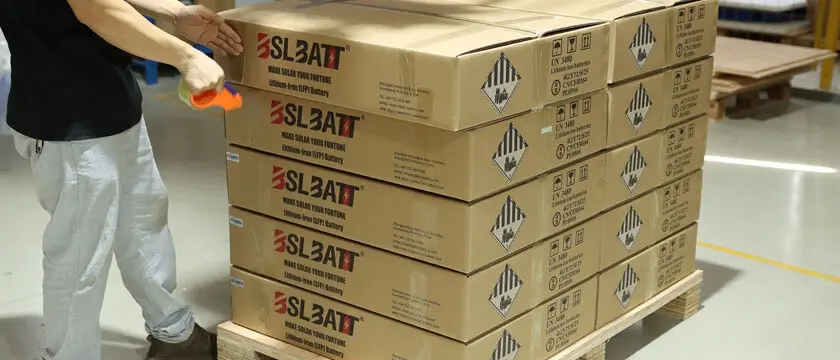
LiFePO4 batteries are the chemistry of choice for energy storage, RV systems, and solar products—thermally stable, long-cycling, and increasingly cost-competitive. But from a transport regulator’s perspective, they are still lithium batteries: Class 9 dangerous goods, governed by the IATA Dangerous Goods Regulations for air and the IMDG Code for sea. That classification shapes everything about getting them from a Chinese factory to your warehouse.
The Compliance Baseline, in One Paragraph
Every lithium cell and battery must have a UN38.3 test report—per the UN Manual of Tests and Criteria, an eight-test series covering altitude simulation, thermal cycling, vibration, shock, external short circuit, impact/crush, overcharge, and forced discharge—before it can legally move internationally. Your logistics job starts where that report ends: correct classification, correct state of charge, correct packaging, and correct paperwork. Get those four right and battery freight is routine; get one wrong and carriers, ports, and customs will stop the shipment cold.
Step 1: Classify the Shipment Correctly
The UN number depends on configuration:
- UN 3480: lithium-ion batteries shipped standalone (the most restricted category).
- UN 3481: lithium-ion batteries contained in equipment or packed with equipment (e.g., an energy storage unit with modules installed, or a power station in retail packaging).
Most freight rejections trace back to a mis-declared UN number. Confirm with your supplier exactly how the goods will ship—loose cells, modules, or installed in equipment—and make sure the booking, the SDS, and the labels all say the same thing.
Step 2: Assemble the Paperwork Before Booking
Carriers will ask for, in order of likelihood:
- UN38.3 test summary for the exact cell and pack models shipping (a cell-level report does not cover a pack; packs must be tested as configured). Reports aligned to current standards matter—air shipments now reference the IATA DGR 67th edition (effective December 2025), and sea shipments the IMDG 42-24 amendment in force since January 2026.
- SDS/MSDS (Safety Data Sheet) for the battery, bilingual if Chinese export inspection applies.
- 1.2-meter drop test evidence for standalone battery packaging.
- Dangerous goods declaration with the correct UN number, class, and packing instruction.
Reputable Chinese battery factories ship UN38.3-compliant product routinely and produce these documents on request—ask for the full document set before paying the balance, not after the truck arrives at the port.
Step 3: Choose the Mode Realistically
Sea freight is the default for LiFePO4, and the gap has widened. Air freight imposes a ≤30% state of charge limit on standalone lithium-ion batteries tendered for transport, which is commercially awkward for batteries sold by usable capacity—and for larger packs, cargo-aircraft-only restrictions and packaging requirements push air rates to multiples of sea rates. Express couriers (DHL, FedEx) apply their own watt-hour thresholds and often decline standalone power banks and large packs entirely.
Sea transport under the IMDG Code accepts higher states of charge and full-container volumes, with proper Class 9 labeling, segregation from certain cargo, and documentation. For ESS containers and rack batteries, sea is essentially the only viable mode. Plan lead times accordingly: battery bookings should be confirmed at order placement, because DG slots on vessels and the accompanying documentation reviews add days that standard freight does not.
Step 4: Manage Cost Structure
Battery logistics costs have three layers buyers often underestimate:
- DG surcharges: carriers add dangerous-goods handling fees on top of standard ocean rates.
- Packaging compliance: UN-spec boxes, separation of terminals, and drop-tested pack configurations cost more than standard cartons—and are non-optional.
- Insurance: standard cargo policies may exclude or restrict lithium batteries; verify your policy explicitly covers Class 9 cargo at the declared value.
A supplier quoting “FOB price plus cheap freight” without mentioning DG handling is not necessarily dishonest—but the cheap freight quote will not survive contact with a DG booking desk.
A Pre-Shipment Checklist
- UN38.3 test summary for cell and pack, current revision
- SDS/MSDS matched to shipping configuration
- Correct UN number (3480 vs 3481) on all documents
- ≤30% SOC confirmed for any air leg
- Class 9 labels and lithium battery mark on every package
- DG declaration booked with a forwarder experienced in Class 9
- Insurance certificate covering lithium battery cargo
Sourcing energy storage hardware? Explore verified energy storage manufacturers, or Submit your RFQ to get matched with battery suppliers that ship fully documented, DG-compliant product.