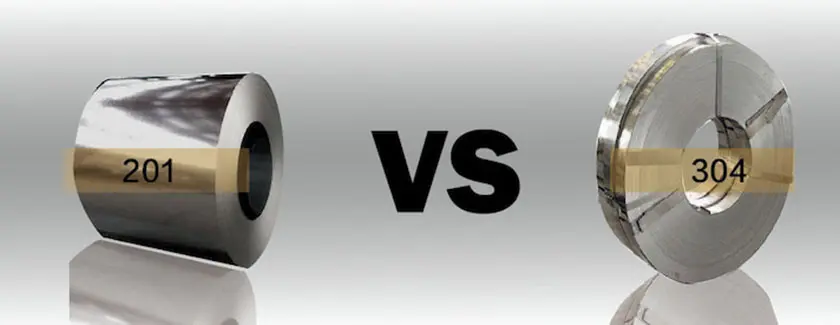
Two chairs can leave the same factory gate looking identical and perform completely differently eighteen months later. The difference is usually a single digit in a material certificate: 201 or 304. Both are austenitic stainless steels; both polish to the same silver; both pass a visual inspection. But they are not the same material, and furniture buyers who treat them as interchangeable eventually fund a rust-complaint program.
The Chemistry That Decides Everything
Stainless steel resists rust because chromium forms a passive oxide layer on the surface. Both grades have enough chromium to qualify—roughly 16–18% for 201, 18–20% for 304. The divergence is nickel and manganese:
- 304 (18/8): about 18% chromium and 8–10.5% nickel, per the ASTM A240 composition specification. Nickel stabilizes the corrosion-resistant structure.
- 201: the same chromium range but only 1–2% nickel, with 5.5–7.5% manganese substituted to keep the steel workable and hold costs down. Nickel is the expensive element; manganese is cheap.
That substitution is the entire story. 201 was developed as a cost-engineered grade, and its corrosion resistance—particularly against chlorides like sweat, coastal air, cleaning chemicals, and road salt—is a fraction of 304’s. In benign indoor environments the difference may never surface. In anything harsher, it surfaces fast: tea staining, pitting at welds, and rust blooms at joints where moisture collects.
Where Each Grade Belongs
304 is the floor for anything that touches:
- Outdoor or semi-outdoor use (patio sets, balcony furniture, poolside)
- Food service (tables, trolleys, kitchen shelving)
- Coastal or humid climates
- High-touch surfaces exposed to skin oils and cleaning chemicals
201 is defensible only for:
- Dry, climate-controlled interiors
- Decorative components with no structural or corrosion duty
- Price-driven lines where the replacement cycle is short and the rust risk is honestly disclosed
The grey zone is “indoor but humid”—entryways, spas, garden rooms, hospitality terraces under cover. Buyers should treat these as outdoor duty and specify 304.
The Sourcing Traps
The certificate bait-and-switch. 201 and 304 trade on the same commodity markets with a visible price gap, and substitution mid-contract is one of the most common material frauds in furniture sourcing. Countermeasures:
- Specify the grade in the PO by standard and composition—“SUS 304, 18/8, per GB/T 3280” or “ASTM 304”—not “stainless steel.”
- Verify per lot with XRF. A handheld spectrometer reads alloy composition in seconds; any third-party inspector carries one. For program volumes, require a material test report per shipment.
- Magnet spot-check. Both 201 and 304 are nominally non-magnetic, but heavily cold-worked areas of either can show slight magnetism—so a magnet is a screen, not a verdict. XRF is the verdict.
The weld zone. Corrosion attacks welds first, where heat alters the microstructure. A 201 frame with welded joints in a humid environment rusts at the joints even when the tubes stay clean—one reason cheap chairs fail at exactly the points that carry load. If your design is welded 201, your corrosion exposure is concentrated precisely where mechanical failure is most dangerous.
The “outdoor rated” claim. There is no universal standard behind marketing phrases like “rust-proof” or “all-weather stainless.” Ask the specific question: which grade, per which standard, and what salt-spray test result? A 304 frame with proper welds and passivation will typically survive neutral salt-spray testing for hundreds of hours; 201 struggles past a fraction of that. The test report is the claim’s only meaning.
Price Reality
201 typically trades at a meaningful discount to 304—the gap tracks nickel prices and is rarely subtle. If a “304” quote arrives at 201-level pricing, the material is not 304. The discount is legitimate when the duty matches the grade; it is fraud when a 201 frame is sold as 304. The buyer’s defense is identical in both cases: written grade specification plus per-lot verification.
The Decision Rule
Ask one question: where will this furniture live, and what happens there when it rusts? If the answer involves safety, food contact, outdoor exposure, or a brand reputation that survives on reviews—304 is the floor, and the premium is the cheapest insurance in the BOM. If the answer is a dry showroom with a two-year replacement cycle, 201 honestly specified is a rational cost choice. The expensive outcome is never 201 or 304—it is discovering which one you bought after the containers arrive.
Sourcing stainless furniture with documented grades? Browse verified furniture manufacturers, or Submit your RFQ with your grade specification and get matched with factories that certify per lot.