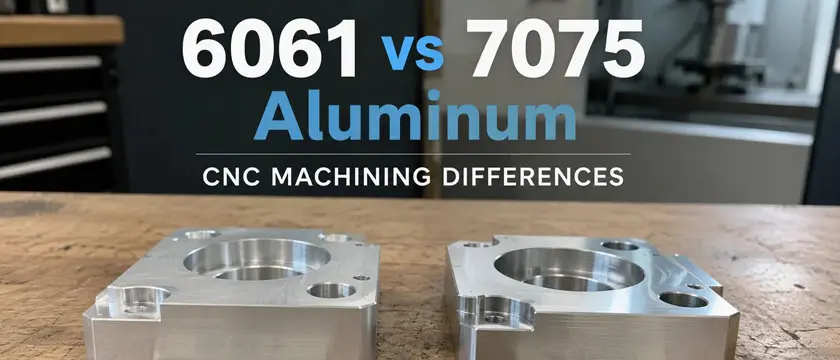
Two aluminum alloys dominate CNC machining quotations: 6061-T6 and 7075-T6. They machine on the same mills, anodize in the same baths, and look identical in the parts bin—yet 7075 typically costs a meaningful premium per kilogram and exists for a reason. The mistake is paying the premium when 6061 carries the load, or worse, saving the money when only 7075 survives the duty.
The Alloys in Composition
6061 is the workhorse: magnesium-silicon (Mg₂Si) precipitation hardening, with copper content kept low. In its common T6 temper (solution-treated and artificially aged), typical published properties put ultimate tensile strength on the order of ~310 MPa, with excellent corrosion resistance, good weldability, and the best cost-to-capability ratio in the 6000 series.
7075 is the strength specialist: zinc is the primary alloying element (~5.6–6.1%), with magnesium and copper contributing. In T6 temper, typical published UTS figures run ~570 MPa or higher—roughly 80–90% stronger than 6061-T6—with yield strength to match. The price of that strength: notably poorer corrosion resistance without protection, poor weldability, and a stress-corrosion-cracking sensitivity that experienced designers respect.
Where the Difference Actually Lands
Strength per dollar is 7075’s argument. In weight-critical or load-critical parts—airframe fittings, drone arms, robotics structural links, premium bicycle and motorsport components—7075 allows thinner sections for the same safety margin, which can offset its material premium with less machining time and less mass. If the part’s failure has safety or performance consequences and every gram matters, 7075 is often the total-cost winner despite the per-kilo price.
Processability is 6061’s argument. It welds (7075 weldments lose most of their heat-treated strength at the joint and crack readily), it anodizes beautifully with less color drift, it machines with longer tool life and more forgiving parameters, and its scrap and rework rates are lower. For brackets, housings, frames, heat sinks, and general structural parts where safety factors are comfortable, 6061 delivers 90% of the outcome at a fraction of the risk.
Corrosion splits the difference. Bare 6061 survives marine-adjacent and humid service respectably; bare 7075 does not—its high copper content drives intergranular attack, and stress-corrosion cracking has grounded aircraft over it. If the part lives outdoors or near salt and will not be hard-anodized or painted, that alone can disqualify 7075.
The Machining Reality
Machinists read the two alloys differently. 7075’s higher strength work-hardens less but loads tools more; feeds and speeds need adjusting, and thin-wall features chatter sooner. Most shops quote 7075 parts with a modest machining premium over identical 6061 geometry—not only for material cost but for process windows. Tight-tolerance parts in 7075 also demand stress-relief awareness: the alloy’s residual stress profile distorts parts relieved from the vise differently than 6061.
Common Specification Errors
- “Aircraft aluminum” as a spec. Both alloys fly; the phrase buys nothing. Specify the temper too—T6 is assumed, but T651 (stress-relieved by stretching) exists precisely for machining stability, and long, thin parts deserve it.
- Welding either alloy casually. 6061 weldments lose ~half their strength in the heat-affected zone and need re-aging; 7075 should generally not be welded at all in structural duty.
- Skipping the surface protection on 7075. If corrosion exposure is possible, hard anodizing (see our finishing comparison) or a conversion coat plus paint is not optional—it is the license to use the alloy.
- Material substitution mid-program. The price gap invites shops to run 6061 when the PO says 7075 (and the reverse, for shops holding 7075 stock). For strength-critical parts, require mill certificates per lot; a handheld XRF confirms alloy identity in minutes.
The Decision Rule
Ask what failure costs. If a failed part means recall, injury, or a product that cannot hit its weight target—7075, protected, with per-lot material certificates. If the part is structural but conventional, serviceable, and cost-driven—6061-T6 is the professional default, and the premium belongs elsewhere in the BOM. The wrong choice is rarely dramatic; it is a housing that corrodes at the coast, a weld that cracks, or a part that carries fifty grams it did not need.
Machining parts in the right alloy? Browse precision engineering manufacturers, or Submit your RFQ with your load cases and environment to get matched with shops that quote by alloy and temper, not by habit.