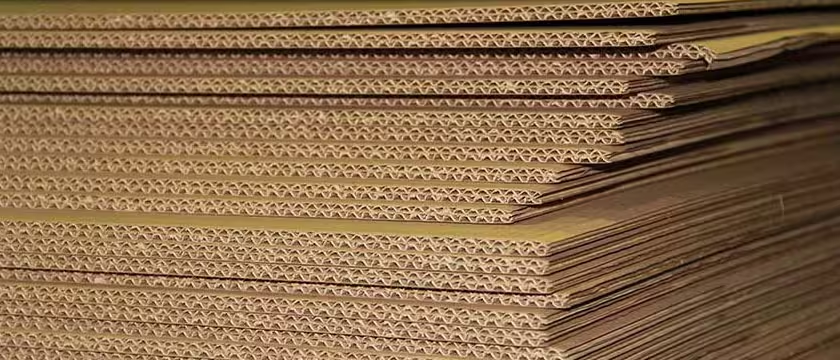
Ask for a “corrugated box” and the factory will ask back: which flute? The letter on the specification—E, B, C, or a double-wall combination like BC—decides three things buyers care about separately but must choose together: how well the box prints, how much weight it stacks, and how much space it burns in a container. Here is what the letters actually mean.
The Alphabet in Millimeters
A flute is the arch-shaped wave sandwiched between liner papers, and the letter codes run by size. Typical profiles, consistent across industry references:
| Flute | Height (approx.) | Flutes per 300 mm | Character |
|---|---|---|---|
| E | 1.1–1.6 mm | ~90+ | Fine, smooth, print-friendly |
| B | 2.5–3.0 mm | ~50 | Balanced puncture and crush |
| C | 3.5–4.0 mm | ~40 | Best stacking compression per weight |
| A | 4.5–5.0 mm | ~34 | Maximum cushioning; less common today |
Micro-flutes (F at ~0.8 mm, G at ~0.6 mm) exist for premium retail cartons where board thinness is the point.
Two cautions on the numbers. First, flute height is measured excluding the liners—total board thickness is greater. Second, manufacturers run tolerance bands, so the height in the spec sheet is a range; the corrugator’s own technical data sheet governs.
Single-Wall Decisions
E flute is the retail carton. Its fine profile takes offset and flexo printing with near-solid-board smoothness, dies crisply, and folds into tight, presentable boxes—hence its dominance in e-commerce mailers and shelf-ready packaging. What it is not: a shipping workhorse. Stack E-flute cartons three pallets high in a humid warehouse and the bottom layer starts to worry.
B flute is the utility player. Thicker arch, better puncture and crush resistance, still acceptable print surface. B-flute cartons handle moderate stacking and rougher handling—typical for subscription boxes and mid-weight consumer goods shipping in their own packaging.
C flute is the freight box. Its taller arch absorbs vertical compression best per unit of paper weight, which is why single-wall C has been the default secondary packaging for decades—shipping cartons that get palletized, double-stacked, and rained on at docks. Its print surface is coarser, and its thickness costs internal volume: a C-flute shipper is roughly 3–4 mm larger in each dimension than an E-flute equivalent for the same internal space.
Double-Wall: BC and Friends
Double-wall board laminates two flute layers (five paper layers total) and changes the category entirely. BC flute—a B layer plus a C layer, roughly 6–7 mm total—is the workhorse for anything heavy, fragile, or export-distance: machinery, ceramics, multi-bottle spirits, consolidated e-commerce. The combined profile pairs C’s stacking strength with B’s puncture resistance, and the redundancy matters: damage that crushes one flute layer often spares the second.
Other combinations trade properties deliberately: EB pairs E’s print surface with B’s strength for retail-ready transit cartons; AC maximizes cushioning for fragile bulk; EE doubles down on fine surface for premium display. The pattern is always the same—one flute provides the primary duty, the second provides insurance.
Matching Flute to Freight
The disciplined sequence:
- Start with the pallet, not the product. Stacking height, warehouse dwell time, and humidity decide the compression requirement before flute choice is even discussed.
- Add the handling reality. Parcel networks (drop, crush, vibration) punish B and below for heavy contents; palletized LCL favors C or double-wall.
- Subtract for print. If the carton is the retail surface, E or EB is the ceiling of your print quality—budget accordingly.
- Test, don’t assume. The International Safe Transit Association (ISTA) protocol family defines standard pre-shipment test sequences (drop, vibration, compression); a morning of lab testing answers what a spreadsheet argues about. For any recurring shipper, an ISTA 1A or 3A sequence on the actual packed product is the cheapest insurance in the packaging budget.
The Spec Traps
- “5-ply” without letters. Five-layer could be BC, AC, or EE—vastly different boards. Always specify the flute combination, not the ply count.
- Gram weight silence. Two BC boards with different liner papers (kraft vs. test liner, 125 gsm vs. 175 gsm) are different products. Specify liner grades with the flute.
- Humidity blindness. Corrugated loses strength as it absorbs moisture—planning compression ratings around dry-lab numbers is how pallet stacks fail in monsoon-season ports.
Ready to spec corrugated packaging that survives the journey? Browse eco-packaging manufacturers, or Submit your RFQ with your product weight, pallet pattern, and print needs to get matched with factories that engineer board, not just quote it.