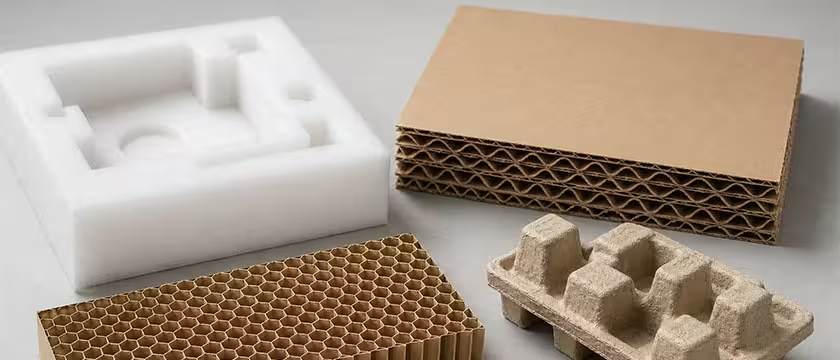
The insert inside the box is the cheapest part of the package and the one that absorbs the most expensive risks—impact, vibration, and the returns that follow. Three materials split the job in Chinese packaging supply chains: EVA foam, EPE (expanded polyethylene, “pearl cotton”), and kraft honeycomb paper. They quote in the same conversations, photograph similarly, and protect nothing alike.
The Materials in Brief
EVA (ethylene-vinyl acetate) is the premium, toolable foam. Produced in sheets of defined density and hardness (typically quoted in Shore C or by kg/m³), it laser-cuts or die-cuts into precise cavities that hold a product like a mold. Its strengths: excellent shock absorption tuned by density, a premium soft-touch feel, reliable dimensional stability for tight-tolerance parts, and crisp presentation—EVA is the unboxing-material of choice for electronics, tools, watches, and cosmetics. Its limits: the highest cost of the three, and an environmental profile (a cross-linked polymer foam) that is difficult to recycle and increasingly questioned by sustainability programs.
EPE (expanded polyethylene) is the volume workhorse: extruded foam with a pearl-like texture, sold in rolls and sheets, cut, die-cut, or heat-formed into shapes. Its strengths: low cost, light weight, good moisture resistance, decent multi-drop cushioning at adequate thickness, and a recyclability story (polyethylene, material category 4) that passes most eco-screening. Its limits: a spongy, less precise aesthetic—EPE inserts read as functional, not premium—and thickness dependence: it cushions well only when given enough millimeters, which eats carton volume.
Kraft honeycomb is the paper route: kraft paper expanded into a hexagonal-cell block, then die-cut or pressed into shapes, often laminated with a top layer for surface finish. Its strengths: fully paper-based (recyclable with the corrugated stream), strong flat-crush resistance for stacking duty, good rigidity at low weight, and the strongest sustainability narrative of the three—hence its rapid adoption in eco-positioned brands and EU-bound e-commerce. Its limits: weaker multi-angle impact absorption than foams (it is a crush material more than a bounce material), sensitivity to humidity, and shape complexity limited by paper’s forming behavior.
Head-to-Head
| Dimension | EVA | EPE | Honeycomb paper |
|---|---|---|---|
| Cushioning (repeated drops) | Excellent | Good (needs thickness) | Good (crush absorption) |
| Precision fit / presentation | Excellent | Moderate | Moderate–good |
| Cost position | Highest | Lowest | Middle |
| Weight | Heaviest | Lightest | Light |
| Recyclability | Difficult | Recyclable (LDPE/HDPE stream) | Fully paper-recyclable |
| Moisture sensitivity | Low | Low | High (unprotected) |
| Custom tooling behavior | Lasers/dies precisely | Dies well; heat-forms | Dies; limited deep draws |
Matching Material to Product
Choose EVA when the product is premium and the unboxing is part of the product—consumer electronics, beauty devices, instruments, gifts. Precision fit is the functional requirement: a loose product damages itself inside its own box. Budget for it as part of the product experience, not packaging overhead.
Choose EPE when volumes are high, budgets are tight, and the duty is protection rather than presentation—appliance accessories, glassware under a threshold, industrial parts. Specify it by density and thickness, and give it room: an EPE spec that saves carton volume is an EPE spec that fails the drop test.
Choose honeycomb when the destination market’s sustainability expectations (or the brand’s) outweigh marginal protection differences, the product has flat or gently curved geometry (bottles, jars, flat-pack goods), and humidity exposure in transit is controlled. For EU e-commerce especially, honeycomb increasingly answers the dual question “protected and recyclable?"—and it ships flat, saving inbound freight volume before conversion.
The Verification Discipline
Whatever the material, protection claims are test claims. Three disciplines apply:
- Test the packed configuration, not the material. ISTA drop/vibration/compression sequences on the actual packed product settle protection arguments in an afternoon (see our flute selection guide for the testing rationale).
- Specify density and thickness in writing. “EVA insert” and “EPE insert” are families; 38 kg/m³ EVA and 18 kg/m³ EPE behave differently than their denser or lighter cousins. The PO names the numbers.
- Watch the sustainability claims. “Recyclable” means different things per market—foam EVA is rarely accepted in curbside streams anywhere, EPE depends on local film-recycling access, honeycomb inherits the paper stream. For EU-bound SKUs, align insert material with the packaging claims your marketing makes; regulators increasingly read them literally.
The Cost Trap
Engineering a downgrade from EVA to EPE or honeycomb saves unit cost and can silently increase total cost—the classic pattern being a premium product whose damage rate doubles to save thirty cents of insert. The arithmetic to run: insert cost saved per unit, times units shipped, versus damage/return rate delta, times fully-loaded cost of a return. For products above a modest price point, protection is almost never where to economize.
Ready to engineer packaging that protects and presents? Browse eco-packaging manufacturers, or Submit your RFQ with your product fragility and market requirements to get matched with factories that test, not guess.