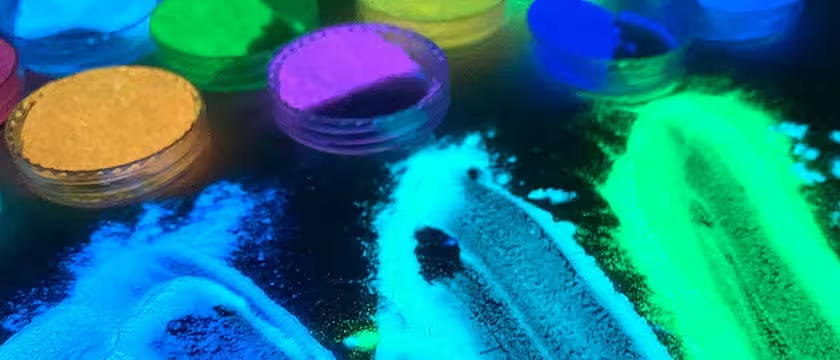
Photoluminescent pigment is a category where the spec sheet reads like poetry — “12-hour afterglow,” “high brightness” — and the invoice arrives per kilogram. Our October 2026 sampling puts industrial-grade reference bands on all five product classes, and the grading logic turns out to be refreshingly mechanical: duration, brightness, and encapsulation move the price; color mostly doesn’t.
Price data source: publicly listed wholesale prices on mainstream B2B platforms, collected on 2026-10-18. These are reference ranges only — actual transaction prices vary significantly with order quantity and customization requirements. For full methodology, see Understanding Reference Prices.
The Five Bands
| Product Class | Reference Range | Unit | Band Logic |
|---|---|---|---|
| Blue-Green Glow Powder (Epoxy Grade) | 9.50 – 50.00 | kg | Standard blue-green grades; high-brightness long-afterglow grades at the top |
| Strontium Aluminate Glow Powder | 10.50 – 40.00 | kg | Standard yellow-green SrAl₂O₄ in kilogram lots; long-afterglow high-brightness grades at the top |
| Waterproof Encapsulated Pigments | 15.00 – 80.00 | kg | Base waterproof-coated grades; fully encapsulated high-brightness grades at the top |
| Long-Afterglow Yellow-Green Powder | 18.00 – 45.00 | kg | Performance tier — 12-hour-plus afterglow grades dominate the band |
| UV Fluorescent Security Pigments | 60.00 – 100.00 | kg | Security-ink chemistry, small-lot specialty pricing |
Reading 1: Afterglow Duration Is the Master Price Axis
Put the three mainstream aluminate bands side by side and the rule emerges. Entry kilogram lots of standard yellow-green open at $10.50/kg; the same chemistry family in its long-afterglow, high-brightness configuration runs $18–45/kg, with 12-hour-plus performance grades clustered at $20–30. You are not paying for powder — you are paying for the rare-earth dopant engineering that holds luminance through the night. When a supplier quotes both ends of this range, the first question is not “which is cheaper” but “how many hours of afterglow does the application actually need.”
Reading 2: Color Is a Feature, Not a Cost
Blue-green and yellow-green bands overlap almost completely ($9.50–50 versus $10.50–40). In strontium aluminate chemistry, emission color is tuned by composition tweaks that cost far less than the brightness work. Design teams can pick color on aesthetics; only the performance grade moves the budget.
Reading 3: Encapsulation and Water Chemistry
Waterproof encapsulated grades command $15–80/kg — a band that overlaps the mainstream tops but extends nearly twice as high. The spread tracks coating depth: surface-treated waterproof coatings at the low end, full micro-encapsulation for water-based paint systems at the top. Match the encapsulation level to the carrier system (epoxy, solvent paint, water-based paint); buying full encapsulation for a solvent system is paying for chemistry the binder never challenges.
Reading 4: The Security Tier Is a Different Industry
UV fluorescent security pigments sit apart at $60–100/kg — not glow-in-the-dark chemistry but daylight-invisible fluorescent systems for inks and anti-counterfeit printing. One honesty note: our band rests on only two sampled listings (the dedicated security-pigment search pages would not render during collection), so this band carries lower confidence than the other four and deserves a cross-platform check before you anchor a security-printing program to it.
Quantity Tiers and the Retail-Tier Trap
Two structural notes from the sampling floor. First, lot size moves real money: within a single supplier family, 1 kg and 100 kg quotes diverged by up to 2× — kilogram lots are sampling economics, tonne conversations are manufacturing economics. Second, this category’s search results are heavily polluted by retail tiers: nail-art jars, cosmetic-grade mini packages, a recurring $119/kg retail listing, and $1-per-bag lead-generation prices all interleave with industrial lots. Our bands keep only kilogram-scale industrial listings; if your own benchmarks blend retail grams with wholesale kilograms, the comparison was broken before it began.
Buying by Application
- Epoxy crafts and consumer resin goods: blue-green or yellow-green standard grades at $10–20/kg; brightness beyond this tier is wasted on decorative glow.
- Safety signage and egress marking: long-afterglow high-brightness grades at $20–45/kg — here duration is the product.
- Water-based paint systems: encapsulated grades matched to the binder; solvent systems can often stop one encapsulation tier down.
- Security printing: the $60–100 UV tier, verified per the caveat above.
Caveats
All figures are ex-factory-style listing prices excluding shipping, duties, samples, and application testing. This batch is a single-platform snapshot; rare-earth input costs move these bands within quarters, and the security-pigment band carries a two-sample confidence flag. Re-validate before program commitments.
Related products: Strontium Aluminate Glow-in-the-Dark Powder · Waterproof Encapsulated Photoluminescent Pigments · UV-Reactive Fluorescent Pigments for Security Ink
Methodology: Understanding Reference Prices on Product Pages
Ready to move from reference ranges to binding quotes? Submit an RFQ with your afterglow-duration target, carrier system, and lot size — and compare written quotations against the bands above.