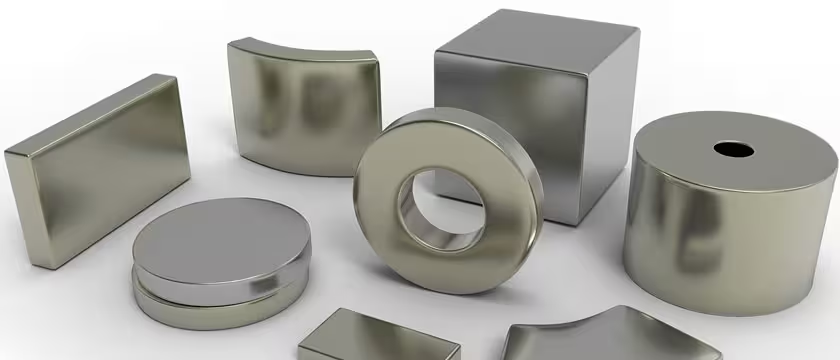
A neodymium magnet quotation reads like a license plate: N35, N42, N52, N42SH. The numbers move the price visibly—an N52 disc can cost around twice an equivalent N42—and most buyers either overpay for strength they cannot use or underpay for heat they did not anticipate. Both mistakes trace to misunderstanding what the numbers actually certify.
The Number: Maximum Energy Product
The “N” stands for neodymium (the Nd in NdFeB—neodymium-iron-boron), and the number is the magnet’s maximum energy product (BHmax) in MGOe (mega-gauss-oersteds). In practical terms: magnetic energy stored per unit volume. N35 is rated at roughly 35 MGOe; N52, the strongest standard commercial grade, at roughly 52 MGOe. Higher number, same size, stronger magnet—at the same dimensions, an N52 delivers roughly 20–40% more pull than an N35, with N42 the common industrial midpoint.
Two crucial corollaries buyers miss:
- Grade is not a force guarantee. Pull force at your air gap depends on geometry, coating, and circuit design as much as grade. A thick N35 often outperforms a thin N52 in a real assembly.
- Size beats grade. Doubling magnet volume adds more force than jumping two grade steps, for less money. Grade shopping before geometry optimization is buying premium fuel for a misaligned engine.
The Letter: Temperature Class
The suffix encodes coercivity—resistance to demagnetization—and therefore maximum operating temperature. Standard grades (no suffix, or “N”) are rated to about 80°C. As heat rises, the picture inverts: past roughly 60–80°C, a standard high-grade magnet can demagnetize faster than a lower, higher-coercivity grade, because the premium grades trade thermal stability for raw energy. Industry practice adds suffixes for heat duty—H (~120°C), SH (~150°C), UH (~180°C), EH (~200°C)—each step raising coercivity (often with dysprosium additions) at a price premium.
This is the most common specification failure in the category: a motor, sensor, or automotive application running at 100°C specified with N52, which performs beautifully on the bench at 25°C and degrades in the field. For warm environments, the correct spec is often a lower N-number with a heat suffix—N42SH beats N52 in a hot motor housing.
Reading a Grade String
| Grade element | Meaning | Buyer’s note |
|---|---|---|
| N | Neodymium (NdFeB) material family | — |
| 35–52 | BHmax in MGOe | Strength density; higher = stronger per volume, pricier |
| (none)/M/H/SH/UH/EH | Coercivity class → max operating temperature | ~80°C / 100°C / 120°C / 150°C / 180°C / 200°C |
Grade strings are standardized across the industry (the underlying property test methods are codified in ASTM A977), which means a written grade is verifiable—demand the supplier’s per-lot test report showing remanence, coercivity, and BHmax against the claimed grade.
The Coating Question
Neodymium corrodes aggressively—its iron content rusts, and intergranular attack crumbles the sintered structure. Hence the standard nickel-copper-nickel (Ni-Cu-Ni) plating on nearly all NdFeB; epoxy, zinc, and gold finishes serve marine or medical duty. Two sourcing rules: coating quality is as grade-critical as the grade itself (a porous plating failure destroys an N52 as fast as an N35), and thin or bargain coatings on outdoor-duty magnets are a returns generator regardless of grade chosen.
Over-Specification, the Quiet Budget Killer
Industry experience converges on a pattern: N42 (or nearby N40–N45) is the workhorse for most consumer and industrial applications, with N35 reserved for cost-driven commodity volumes and N52 for space-constrained designs that genuinely cannot grow. Buyers routinely quote N52 “to be safe” and pay a steep premium for margin their geometry does not need. The professional sequence: design the magnetic circuit first, size the magnet second, and let the grade fall out of the calculation.
Spec Checklist for the PO
- Grade and suffix written in full (e.g., “N42SH”), not “strong magnet”
- Maximum operating temperature of the application stated
- Coating system named (Ni-Cu-Ni minimum; epoxy for marine/outdoor)
- Per-lot test report required (Br, Hcj, BHmax vs. grade)
- Magnetization direction and pattern specified (axial, diametrical, multi-pole)
Sourcing magnets with grades that match the duty? Browse rare earth magnet manufacturers, or Submit your RFQ with your temperature environment and force requirements to get matched with suppliers that certify per lot.