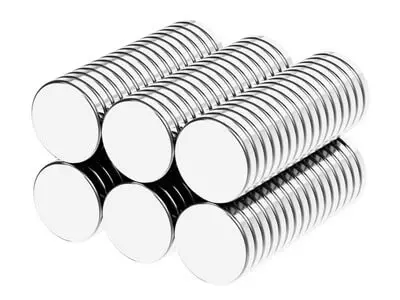
Product Overview
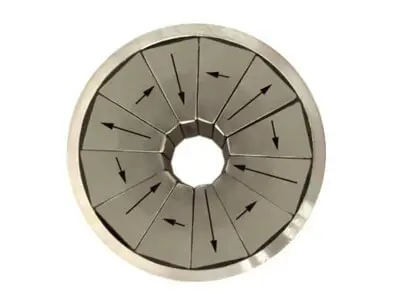
N42SH sits at the practical sweet spot for high-temperature neodymium duty: with intrinsic coercivity of at least 20 kOe it resists demagnetization up to roughly 150°C, making it the standard grade for automotive, compressor and industrial-rotor work where N-grade magnets would irreversibly lose flux. Diametrical magnetization puts the poles on opposite sides of the diameter, so the cylinder behaves like a two-pole rotor element — the format used inside brushless rotors, magnetic angle encoders, speed sensors, magnetic couplings and stirring drives. Manufacturers listed here sinter SH-grade material with dysprosium-containing compositions, precision-grind cylinders to typical ±0.05 mm tolerances, and magnetize diametrically after coating (Ni-Cu-Ni, Zn or epoxy) with pole orientation verified by flux mapping.
Post-coating magnetization verification is the rotor-grade requirement: diametric magnetization after coating must be flux-verified per unit for pole-position accuracy, and buyers should specify pole-angle tolerance documentation, since pole errors directly determine sensor accuracy in angle-sensing applications.
Lot-traceable flux mapping also enables warranty root-cause analysis when field failures occur months after installation.## OEM & Customization Capabilities
- Orientation Options – diametrical, axial or multi-pole magnetization from the same sintered blank.
- Temperature Grades – N38SH–N48SH series, or UH/EH classes to 180–200°C for extreme duty.
- Rotor Integration – press-fit tolerances, shaft bores and magnetization after rotor assembly (post-assembly magnetization) supported.
Industry Applications
- Custom NdFeB Magnets
- Rotor & Sensor Magnets